


Skip to content
TerryWhite Chemmart
Hero Image

Contraception

Contraception (also called birth control or family planning) helps prevent unwanted pregnancies. Several options are available, covering different methods and levels of effectiveness.

New accessibility to emergency hormonal contraception

Emergency hormonal contraceptives Ulipristal (EllaOne) and levonorgestrel (Postella-1) is available for purchase through our online store and app.

To complete your purchase, follow the steps below (this is not required if you have a doctor's prescription):

  1. Visit our online store and proceed through the checkout process
    Shop now
  2. Contact your selected pharmacy as soon as possible after checkout to confirm if the product is appropriate. Your order will be cancelled if not confirmed within 48 hours Find your selected store's contact details HERE
  3. Once the pharmacist confirms your eligibility, the order can be processed

Learn more about emergency hormonal contraception HERE.

Types of contraception and their effectiveness

No form of contraception is 100% effective, but some are more effective than others. For your chosen method to be as effective as possible, it's important to use it correctly.

Before choosing the right option for you, it's important to consider:

  • The effectiveness of each method
  • Your risk of getting a sexually transmissible infection (STI)
  • Cost
  • How easy it is to use
  • Your general health
  • Potential for side-effects
  • Whether you will need to see a healthcare provider
  • And other considerations

Is emergency contraception right for you?

Emergency contraception or ‘the morning after pill’ is more effective the earlier you take it. Within 24 hours is ideal; however, depending on the type of emergency contraception the window can range from 24-72 hours.10

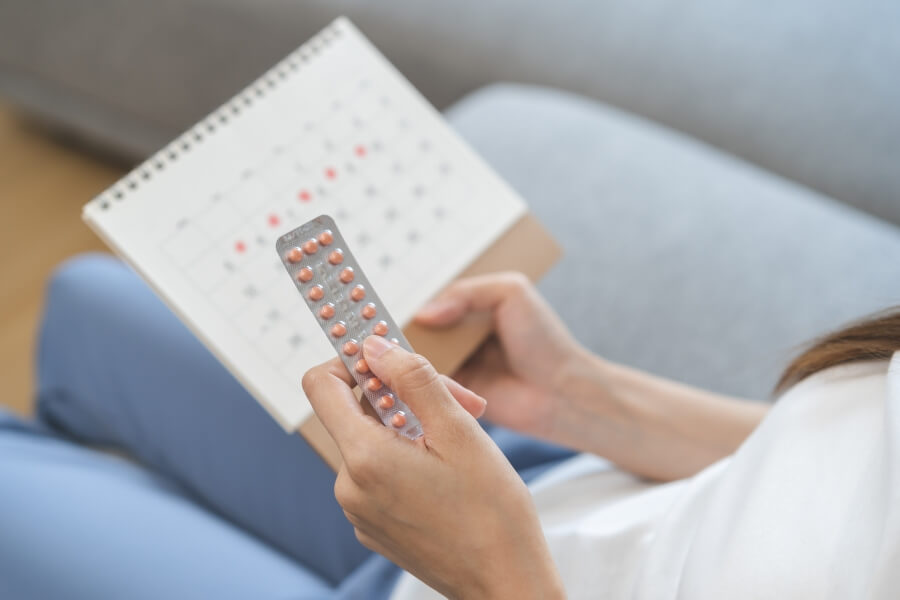
Emergency contraception can be used if you:

  • didn’t use any contraception 
  • forgot to take the pill 
  • have unprotected sex 
  • had sex with a condom and it broke 
  • were sexually assaulted

Emergency hormonal contraceptives are now available for patients to purchase on our online store.

Learn more

Contraception types

Oral contraception  

This is usually known as ‘the pill’. You need to take the pill every day for it to be effective. There are two main types:

  • The combined oral contraceptive pill (COC) contains oestrogen and progestogen and prevents you from ovulating. It is 99.7% effective if taken correctly.1
  • The progestogen-only pill (mini pill) does not prevent you from ovulating. If taken correctly, the mini pill is 99.7% effective. 

Eligible women can now visit a participating TerryWhite Chemmart pharmacy to get a consultation for a resupply of their oral contraceptive pill. Patients can access a 12-month re-supply of certain low-risk oral contraceptive pills for contraception purposes only.

Find out more and book a consultation

Long-lasting reversible contraception (LARC) 

LARC is sometimes called ‘set and forget’ contraception because you don’t have to regularly think about it. There are several types of LARC, which include:2

  • hormonal injections (Depo Provera) – progestogen injections given every 12 weeks  
  • hormonal implants (Implanon®) – an implant inserted under the skin of your inner upper arm that lasts for three years 
  • intrauterine devices (IUDs) 
  • hormonal IUDs (Mirena® or Kyleena®) – last for five years 
  • copper IUDs – last for five to 10 years

LARC is more than 99% effective in preventing pregnancy and is immediately reversible once it’s removed.3

Vaginal ring  

Also called a contraceptive ring or combined hormonal ring, the vaginal ring (NuvaRing®) contains the same type of hormones as the COC.

The ring is placed high inside your vagina, and you can leave it in for up to three weeks. You remove it when you have your period and use a new ring when your period has finished. It’s 99.7% effective if used correctly.4

Barrier methods

Barrier methods include: 

  • external condom, worn over the penis (98% effective) 
  • internal condom, a sheath that fits inside the vagina (over 79% effective) 
  • diaphragm, a soft silicone cap placed inside the vagina (over 82% effective)

This level of effectiveness is based on perfect use. Often barrier methods of contraception are not used properly which can result in 18-20% of pregnancy when using them.5

Permanent contraception

Women can have a tubal ligation or have their ‘tubes tied’. It’s over 99.5% effective.9

Men can have a vasectomy, which is 99.5% effective.10 

These methods are not always reversible and should only be considered if you’re sure you don’t ever want to get pregnant or are sure you have finished having children. 

Oral contraceptive pill (OCP) resupply consultation

Eligible women can now visit a participating TerryWhite Chemmart pharmacy to get a consultation for a resupply of their oral contraceptive pill.

Patients can access a 12-month re-supply of certain low-risk oral contraceptive pills for contraception purposes only. Eligibility applies.

Find out more and book a consultation

Emergency contraception? 

Emergency contraception or ‘the morning after pill’ can be used if you:

  • didn’t use any contraception 
  • forgot to take the pill 
  • have unprotected sex 
  • had sex with a condom and it broke 
  • were sexually assaulted

Emergency contraception is more effective the earlier you take it. Within 24 hours is ideal; however, depending on the type of emergency contraception the window can range from 24-72 hours.10

Choosing the right contraception 

It’s important to choose the right contraception for you. Things to consider include:

  • how easy it is to use? 
  • how effective it is? 
  • how easy it is to access? 
  • how much it costs? 
  • potential side-effects? 
  • is it reversible? 
  • whether it offers protection from STIs

Not all contraceptives are suitable for everyone. For example, some types of hormonal contraception are not recommended for people with blood clots, heart problems or migraines.11


Choosing the right contraception 

 It’s important to choose the right contraception for you. Things to consider include:

  • how easy it is to use? 
  • how effective it is? 
  • how easy it is to access? 
  • how much it costs? 
  • potential side-effects? 
  • is it reversible? 
  • whether it offers protection from STIs

Not all contraceptives are suitable for everyone. For example, some types of hormonal contraception are not recommended for people with blood clots, heart problems or migraines.11

Where can you get contraception?

Contraception, such as LARCs, vaginal rings and the pill is only available with a prescription, so you’ll need to see your doctor to access these forms of birth control.  

The emergency contraception pill is available from a doctor or pharmacist without a prescription. 

You can also buy condoms and diaphragms without a prescription from your TerryWhite Chemmart pharmacy. However, if you choose a diaphragm, it’s recommended you see a doctor or nurse to make sure it fits properly.

Where can you get contraception?

Contraception, such as LARCs, vaginal rings and the pill is only available with a prescription, so you’ll need to see your doctor to access these forms of birth control.  

The emergency contraception pill is available from a doctor or pharmacist without a prescription. 

You can also buy condoms and diaphragms without a prescription from your TerryWhite Chemmart pharmacy. However, if you choose a diaphragm, it’s recommended you see a doctor or nurse to make sure it fits properly.

Complications when using contraception

Contraception and STIs

The only method of contraception that protects you from sexually transmitted infections (STIs) are condoms. You can also use these with other methods of contraception. 

Contraception and breastfeeding 

Breastfeeding delays the return of your period after birth and can be an effective contraceptive as long as you meet all the following conditions:12

  • your periods have not returned 
  • your baby is less than six months of age 
  • you are exclusively breastfeeding, and your baby has no other food or drinks. 

Contraception and menopause

While fertility declines as you get older, you can still get pregnant while you ovulate. The chances of getting pregnant between the age of 45-49 years are 2-3% per year, and after the age of 50, it’s less than 1%.13

If you’re younger than 50 years when you reach menopause and don’t want to become pregnant, you should continue to use contraception for at least two years after your final period.13

If you’re 50 or older, you should use contraception for at least one year after your final period.13

Potential side-effects

 Some forms of contraception can have side effects. Some common side effects from using hormonal contraception include:11

  • irregular vaginal bleeding (spotting)
  • mood changes
  • headaches 
  • skin changes
  • sore breasts
  • nausea

If you have a latex allergy, it’s important to use latex-free condoms. Talk to your doctor about potential side effects you may need to be aware of. 

When to see your doctor

If you’re not sure which contraception to use, see your doctor or a family planning clinic. You may also need to have regular reviews with your doctor for some forms of contraception.

How TerryWhite Chemmart can help

Your qualified TerryWhite Chemmart Pharmacist* can provide care for a broader range of everyday health conditions, including hormonal contraception.

Find out more

Your local TerryWhite Chemmart pharmacist is available to help you manage your health. We can provide expert advice, dispense your prescription contraceptive pill and provide emergency contraception.

We can also recommend different types of contraception, explain how to use them effectively and discuss any potential side effects that may occur.

Find your nearest store

Disclaimer
General advice only – this information should not replace the information provided to you by your healthcare professional. If symptoms are severe or persist, please speak to your healthcare professional. Information current as of date of publishing.
*Pharmacists must undertake specific post-graduate clinical and prescribing training and be authorised by Queensland Health. Eligibility applies.

‎‎

Sources
1Jean Hailes for Women’s Health, Contraception, https://www.jeanhailes.org.au/health-a-z/sex-sexual-health/contraception 
2Family Planning Australia, Long Acting Reversible Contraception (LARC), https://www.fpnsw.org.au/factsheets/individuals/contraception/long-acting-reversible-contraception-larc 
3The Royal Women’s Hospital, Contraceptive pills, https://www.thewomens.org.au/health-information/contraception/contraceptive-pills
4The Royal Women’s Hospital, Vaginal ring, https://www.thewomens.org.au/health-information/contraception/vaginal-ring/ 
5The Royal Women’s Hospital, Condoms and diaphragms, https://www.thewomens.org.au/health-information/contraception/condoms-diaphragms/ 
6Sexual Health Victoria, Withdrawal (pulling out), https://shvic.org.au/for-you/contraception/withdrawal-method-pulling-out 
7Better Health Channel, Contraception – choices, https://www.betterhealth.vic.gov.au/health/healthyliving/contraception-choices 
8Family Planning Australia, Permanent Contraception: Female Sterilisation, https://www.fpnsw.org.au/factsheets/individuals/contraception/permanent-contraception-female-sterilisation
9Family Planning Australia, Permanent Contraception: Male Sterilisation (Vasectomy), https://www.fpnsw.org.au/factsheets/individuals/contraception/permanent-contraception-male-sterilisation-vasectomy 
10Family Planning Australia, Emergency Contraception, https://www.fpnsw.org.au/health-information/contraception/emergency-contraception 
11Healthdirect, Contraception options, https://www.healthdirect.gov.au/contraception-options 
12Australian Breastfeeding Association, Getting pregnant while breastfeeding, https://www.breastfeeding.asn.au/resources/getting-pregnant-while-breastfeeding
13Australasian Menopause Society, Contraception, https://www.menopause.org.au/hp/information-sheets/contraception