


Skip to content
TerryWhite Chemmart
Hero Image

Book your whooping cough vaccination today

Whooping cough/diphtheria/tetanus (dTpa) vaccination

Diphtheria, tetanus and whooping cough (pertussis) are serious diseases that can lead to severe complications, especially for young children, older adults, pregnant women and people with weakened immune systems. The dTpa vaccine helps protect against diphtheria, tetanus and whooping cough in a single vaccination.


Book your whooping cough vaccination now.

National Immunisation Program (NIP) Eligibility

The diphtheria-containing vaccine is available through the National Immunisation Program (NIP) for some eligible people, including:

  • Pregnant women, who are recommended to receive a dTpa vaccine during each pregnancy to help protect their baby from whooping cough  
  • Adolescents aged 12–13 years if routine school-based vaccination was not possible  
  • Eligible people under 20 years of age who require catch-up vaccination because they did not receive recommended diphtheria-containing vaccines in childhood 
  • Refugees and humanitarian entrants of any age who require eligible catch-up vaccination  

Book NIP vaccination

Queensland funded eligibility

In response to the increase in diphtheria cases nationally, Queensland has expanded eligibility for state-funded diphtheria-containing vaccines to include: 

  • All First Nations people aged 20 years and older for:  
  • completion of a 3-dose primary course 
  • a booster dose when the most recent dose was more than 10 years ago 
  • a booster dose when the most recent dose was more than 5 years ago, and the person is travelling to a high-risk area  


If you think you may be eligible under this Queensland program, speak with your pharmacist when booking.  

Book now


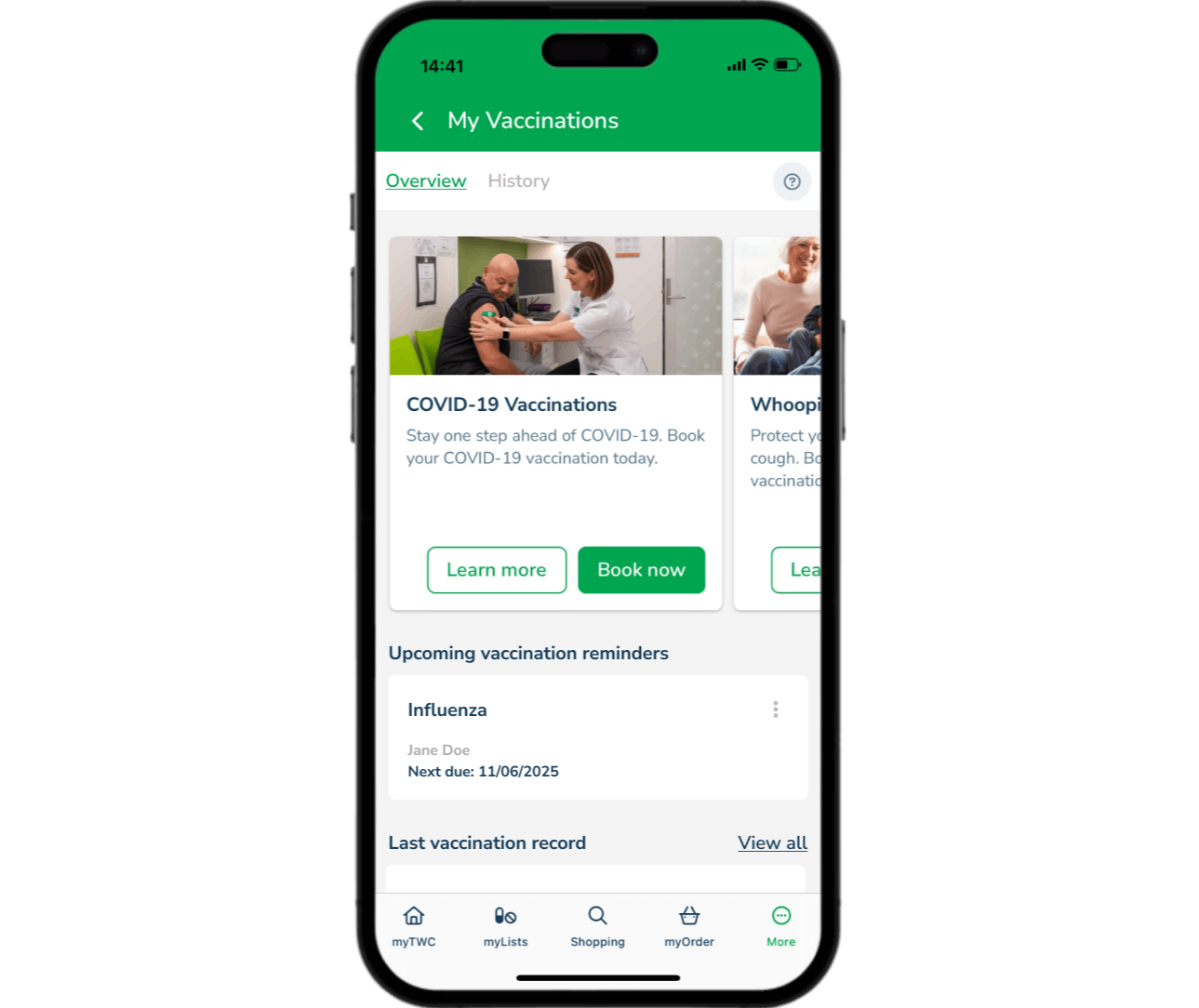
My Vaccination Record

Keep track of vaccinations administered at TerryWhite Chemmart pharmacies via our app, helping you stay up to date with recommended vaccines, view your vaccination history, and receive reminders for upcoming appointments.

Please note, My Vaccination Record is not linked to the Australian Immunisation Register (AIR) and only shows vaccinations given at TerryWhite Chemmart pharmacies via our app.

How do I join My Vaccination Record?

  1. Download the TerryWhite Chemmart app from your app store.
  2. Create an account and link it to your local TerryWhite Chemmart.
  3. Once your TerryWhite Chemmart pharmacist has administered your vaccination, go to the My Vaccinations section in the app.
  4. View your vaccination record and stay on track with reminders for upcoming vaccinations.

Stay informed and in control of your immunisation history with My Vaccination Record.


Download our app today!


My Vaccination Record

Keep track of vaccinations administered at TerryWhite Chemmart pharmacies via our app, helping you stay up to date with recommended vaccines, view your vaccination history, and receive reminders for upcoming appointments.

Please note, My Vaccination Record is not linked to the Australian Immunisation Register (AIR) and only shows vaccinations given at TerryWhite Chemmart pharmacies via our app.

How do I join My Vaccination Record?

Accessing My Vaccination Record is simple and seamless through our app.

  1. Download the TerryWhite Chemmart app from your app store.
  2. Create an account and link it to your local TerryWhite Chemmart.
  3. Once your TerryWhite Chemmart pharmacist has administered your vaccination, go to the My Vaccinations section in the app.
  4. View your vaccination record and stay on track with reminders for upcoming vaccinations.

Stay informed and in control of your immunisation history with My Vaccination Record.


Download our app today!

Your questions answered

dTpa FAQs

What is whooping cough?

Whooping cough (also known as pertussis) is a contagious respiratory infection that causes severe, uncontrollable coughing that can make it hard to breathe. Whooping cough gets its name from the high-pitched ‘whoop’ sound that is made when taking a breath in, although this sound is not always obvious.1, 2

Epidemics of whooping cough occur every 3 to 4 years in Australia, and while there is no clear seasonal pattern, notified cases generally peak during early November.3

Whooping cough can affect people of all ages, but it is most serious for infants under the age of 6 months, as they have soft airways that can be damaged by violent bouts of coughing.2 One in every 200 babies who are infected with whooping cough under the age of six months dies from the condition.4

What is diphtheria?

Diphtheria is a serious bacterial infection that can affect the throat, airways and skin, and in some cases can lead to severe complications. Vaccination is the best way to help protect against diphtheria. In Australia, diphtheria vaccination is given as a combination vaccine that also protects against whooping cough (pertussis) and tetanus

The diphtheria-containing vaccine used in pharmacies is generally a dTpa vaccine, which protects against diphtheria, tetanus and pertussis (whooping cough). This combination vaccine may be recommended as part of routine vaccination, catch-up vaccination, pregnancy vaccination, or booster vaccination in eligible adults. 

What is the Whooping cough/Diphtheria/Tetanus (dTpa) vaccination?

The dTpa vaccination is an inactivated vaccine that is given as a series of vaccinations to protect against diphtheria, tetanus, and pertussis.5

Diphtheria and pertussis spread from person to person. Tetanus enters the body through cuts or wounds.6

DIPHTHERIA (D) is a bacterial infection that is easily spread. It can cause breathing difficulties, skin sores, or inflammation of the heart or nerves.6

TETANUS (T) is a dangerous disease caused by a bacterium present in contaminated soil, dust or animal manure. It enters the body through cuts or open wounds.
It can cause painful muscle spasms, lockjaw, as well as difficulty swallowing and breathing.6

PERTUSSIS (aP), also known as whooping cough, is a bacterial infection spread through droplets from coughing or sneezing. Severe coughing and trouble breathing occur, which can be life-threatening in babies.6

How is diphtheria/whooping cough spread?


Diphtheria can spread through respiratory droplets or through contact with infected skin lesions.

Whooping cough is caused by the bacteria Bordetella pertussis, which is spread from person to person through airborne droplets when an infected person coughs or sneezes. 5, 6

Even if you have been vaccinated against whooping cough, you can still be infected. However, your symptoms are likely to be less severe than those of someone who is not vaccinated.5, 6, 7 

Who should consider a Whooping cough/Diphtheria/Tetanus (dTpa) vaccination?


Diphtheria vaccination is recommended as part of routine vaccination in childhood and adolescence, catch-up vaccination for people who missed doses, booster vaccination in some adults, pregnancy vaccination, and for some travellers or people at higher risk. 

How often do you need a dTpa vaccination?

The dTpa vaccination is recommended for children at 2, 4, 6 and 18 months of age, and then again at four years. Adolescents should receive a booster dose between the ages of 11 and 13, and adults should have a booster at ages 50 and 65 years and over.5

Pregnant women are recommended to receive dTpa during each pregnancy, primarily to help protect their baby from whooping cough. This vaccine also contains diphtheria and tetanus components. 

Do I need a booster?


Immunity against whooping cough fades over time. If you haven't had a whooping cough vaccination in the past 10 years, you will be less protected against infection.5

Ask your GP whether you’re up to date – and if not, book your booster. Doing this will help boost your defence and help protect the young ones in your circle of family and friends.

Who is at risk of whooping cough?

Whooping cough can affect anyone.

However, those who are most at risk of catching the infection are:1, 2

  • babies under six months (this is because babies don’t complete their primary course of vaccination against whooping cough until they are six months old). enough to be fully vaccinated
  • people living with someone who is infected
  • pregnant or breastfeeding women
  • people who travel
  • healthcare workers and early childhood educators
  • those who have not had a whooping cough booster within the last 10 years
  • people over 65 years of age who have not had a booster within the past 10 years

Who should be vaccinated from whooping cough?

  • Healthcare workers, early childhood educators and carers should be vaccinated against whooping cough every 10 years.7
  • Travellers should also be vaccinated if their last booster was more than 10 years ago.7
  • Adult household contacts or carers of infants aged less than six months should be vaccinated at least 2 weeks before having close contact with an infant.7

When should you speak to your pharmacist or doctor?

Speak to your pharmacist or doctor if you are unsure whether you are up to date, need a catch-up course, are pregnant, are travelling, or think you may be eligible for funded vaccination.

Learn more about whooping cough
Here's how whooping cough affects the whole family (and what you can do)  - Find out more, if you are an expecting parent, new parent, grandparent, or if you work with infants and young children

Are yo uunsure about whooping cough? Here's what you should know. You may think that people don't talk about whooping cough as much as the flu or COVID-19, however it is still important to think about - Find out more

Here's how whooping cough affects the whole family (and what you can do)  - Find out more, if you are an expecting parent, new parent, grandparent, or if you work with infants and young children

Are yo uunsure about whooping cough? Here's what you should know. You may think that people don't talk about whooping cough as much as the flu or COVID-19, however it is still important to think about - Find out more

About Immunisation Foundation of Australia 

The Immunisation Foundation of Australia was established by the family of Riley Hughes, who have become vocal advocates of immunisation after the death of their son from whooping cough in 2015. 

Believing in the importance of parents and community-members standing up to support immunisation, the foundation’s mission is to inspire further community-based immunisation advocacy, helping to protect babies and families from vaccine-preventable diseases.

The Immunisation Foundation of Australia envisions a world where families are no longer affected by the unnecessary suffering and death caused by vaccine-preventable diseases. 

To help make this vision a reality, we are committed to creating a network of community-based immunisation champions, who share our common values of respect, integrity and evidence-based advocacy.   
 

For more information, please visit www.ifa.org.au

Disclaimers
*Pricing may incur a surcharge after hours, weekends and public hours.
^A service fee may apply in some pharmacies, please speak to your local pharmacist for more information
References
1Healthdirect, Whooping cough, https://healthdirect.gov.au/whooping cough
2Australian Centre for Disease Control., Whooping cough (pertussis), https://www.cdc.gov.au/topics/whooping-cough-pertussis
3Australian Centre for Disease Control, Whooping cough (pertussis) for health professionals, https://www.cdc.gov.au/topics/whooping-cough-pertussis-health-professionals
4The Kids Research Institute Australia, Whooping cough, https://www.thekids.org.au/our-research/research-topics/whooping-cough/
5Australian Immunisation Handbook, Pertussis (whooping cough), https://immunisationhandbook.health.gov.au/contents/vaccine-preventable-diseases/pertussis-whooping-cough
6NSW Health, Diphtheria, tetanus and pertussis (whooping cough) (dTpa) vaccine, https://www.health.nsw.gov.au/immunisation/Publications/iec.pdf
7Better Health Channel, Whooping cough. https://www.betterhealth.vic.gov.au/health/conditionsandtreatments/whooping-cough
8The Royal Children's Hospital Melbourne, Whooping cough (pertussis), https://www.rch.org.au/clinicalguide/guideline_index/whooping_cough_pertussis/